Ordering food in Japanese
Ordering food in Japanese follows a fixed sequence: state your party size, call the waiter with sumimasen, order by pointing or naming a dish, and ask for okaikei o onegaishimasu — the check — when you're done. Here's the full run, phrase by phrase.
Getting seated
Staff will usually ask nanmeisama desu ka? (何名様ですか?) — "how many people?" — right at the entrance. Reply with the number plus desu: futari desu (二人です) for two people, hitori desu (一人です) for one. Both hitori and futari are irregular readings, worth memorizing on their own since they come up at every restaurant.
If nobody greets you at the door, futari onegaishimasu (二人お願いします) — "two people, please" — works just as well said proactively.
Ordering
Sumimasen (すみません) is how you call a server in Japan — there's no expectation of catching someone's eye or waiting to be checked on, so saying it clearly, sometimes with a raised hand, is completely normal and not rude.
Once someone's at your table:
- Menyuu o kudasai (メニューをください) — Menu, please, if one hasn't already been set down.
- Kore o kudasai (これをください) — This one, please, said while pointing at the menu. This is genuinely the most-used phrase in this entire article — pointing plus kore o kudasai gets you through most menus even with zero Japanese otherwise.
- Osusume wa nan desu ka? (おすすめは何ですか?) — What do you recommend? A natural question at a small restaurant, and staff are generally happy to point at something specific.
Allergies and spice level
For anything you need to avoid, [food] wa haitte imasu ka? ([食材]は入っていますか?) — "does this contain [food]?" — is the direct question. For example, piinattsu wa haitte imasu ka? (ピーナッツは入っていますか?) asks about peanuts specifically; swap in whichever ingredient matters.
If spice is the concern rather than an allergy, karai no ga nigate desu (辛いのが苦手です) — "I'm not good with spicy food" — is a simple, natural way to flag it before ordering, rather than trying to negotiate spice levels dish by dish.
For anything serious — a genuine allergy rather than a preference — it's worth being direct and, where possible, having the specific ingredient written down or shown on a translation app as backup, since haitte imasu ka relies on the kitchen staff knowing every ingredient by name in the moment.
Asking for the check
Okaikei o onegaishimasu (お会計をお願いします) — check, please — is the standard closing phrase, said either to a passing server or, at many restaurants, at the register on your way out rather than at the table.
Splitting a bill evenly is called warikan (割り勘), but a lot of smaller restaurants aren't set up to split one check item by item across a group. It's common for one person to pay the whole thing at the register and get reimbursed afterward, rather than each person paying separately at the table — worth knowing so it doesn't catch your group off guard.
Before and after the meal
Two phrases bookend a Japanese meal and aren't really optional the way "thanks, that was great" is in English. Itadakimasu (いただきます) is said just before eating, roughly "I gratefully receive this" — a habit said even eating alone, not just as a table toast. Gochisousama deshita (ごちそうさまでした) closes the meal out, said when you're finished, whether to a server, a host, or just to yourself.
These are japanese restaurant phrases that come up in nearly the exact same order at almost every meal, which makes them worth having memorized as a sequence rather than as separate vocabulary.
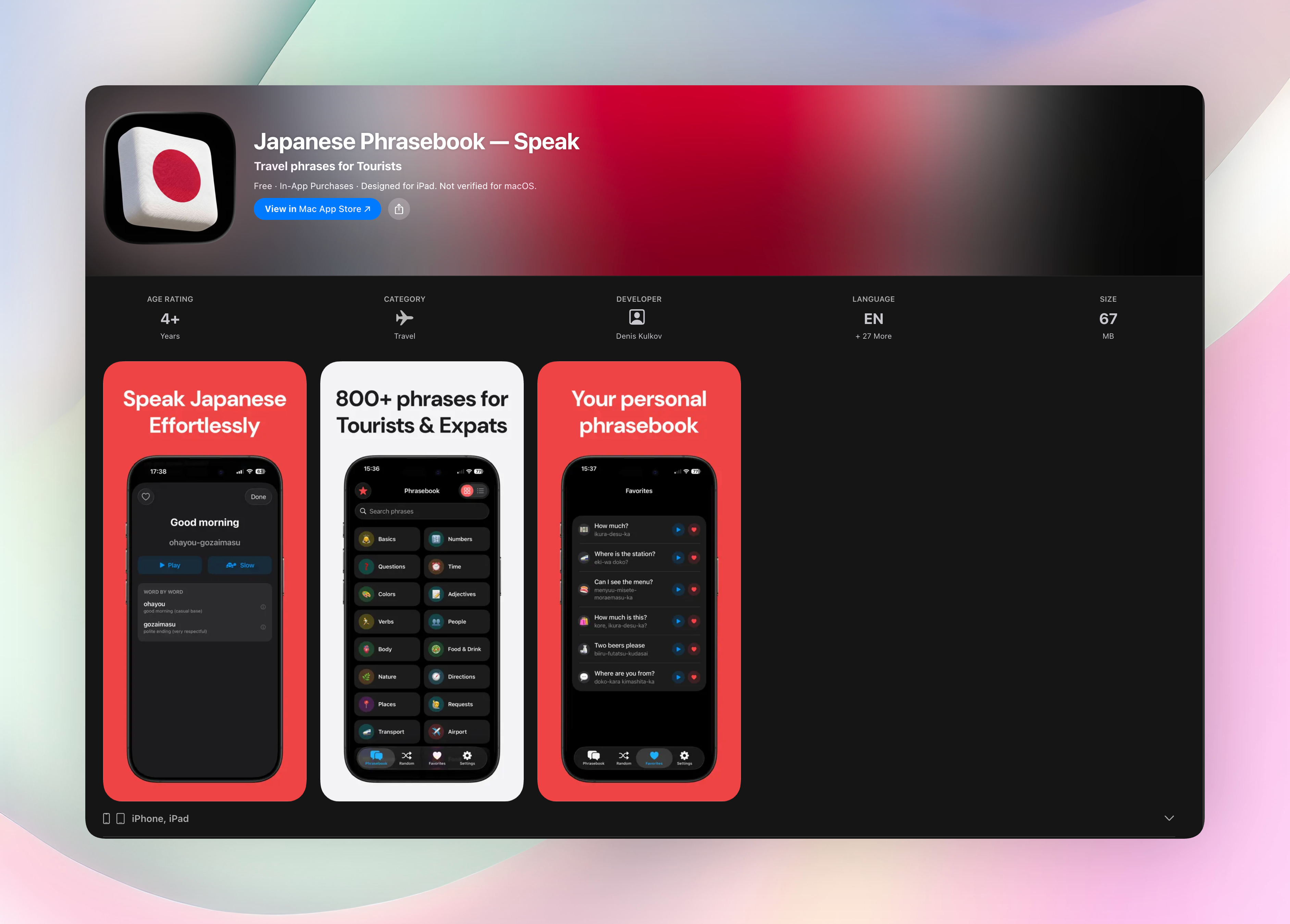
The whole sequence above — seating, ordering, allergies, check — is exactly the kind of real-world scenario Japanese Phrasebook is organized around: an offline app with real-world Japanese phrases by category, including a dedicated food section, each with native audio at full and slow speed and a word-by-word breakdown, so you can hear a phrase like piinattsu wa haitte imasu ka said correctly before you need it at the table.
For the phrases that open and close any interaction, not just meals, see how to say sorry and please in Japanese and the basic Japanese phrases guide.
FAQ
How do you ask for a table for two in Japanese?
Futari desu (二人です) in response to being asked party size, or futari onegaishimasu (二人お願いします) said proactively at the entrance. Both mean "two people."
How do you call a waiter in Japanese?
Sumimasen (すみません), said clearly, sometimes with a raised hand. It's the standard, expected way to get a server's attention in Japan rather than waiting to be noticed.
How do you say you're allergic to something in Japanese?
[Food] wa haitte imasu ka? ("does this contain [food]?") is the direct way to check before ordering. For serious allergies, pairing the question with a written ingredient name or a translation app is a safer backup than relying on the spoken question alone.
What do you say before and after eating in Japan?
Itadakimasu (いただきます) before the meal, and gochisousama deshita (ごちそうさまでした) after. Both are said as a matter of habit, even eating alone, not just as a formality with company.
Free Japanese Phrasebook tools
- Japanese Date ConverterConvert dates between the Gregorian calendar and Japan's modern Meiji, Taishō, Shōwa, Heisei, and Reiwa era notation.
- Japanese Greeting PickerPick a practical Japanese greeting for morning, daytime, evening, or night.
- Japanese Number ConverterConvert whole numbers between Arabic digits and Japanese numerals, with kanji, kana, and romaji readings for prices, quantities, and travel details.
- Konbini Phrase BuilderChoose what you need at a Japanese convenience store and get two ready-to-use phrases.
- Sumimasen Situation ChooserChoose a situation to see how sumimasen works and add a useful follow-up.