Basic Japanese phrases for your trip
Start with five phrases and you can get through most of a day in Japan: konnichiwa (hello), sumimasen (excuse me/sorry), arigatou gozaimasu (thank you), onegaishimasu (please), and eigo o hanasemasu ka (do you speak English). Everything below builds out from those.
Greetings: the basic Japanese phrases you'll use every day
Japanese greetings change with the clock more strictly than English ones do.
- Ohayou gozaimasu (おはようございます) — good morning. Casual version among friends: ohayou (おはよう).
- Konnichiwa (こんにちは) — hello, used from late morning through the afternoon. It's the default all-purpose greeting if you're not sure what else to use.
- Konbanwa (こんばんは) — good evening.
- Oyasuminasai (おやすみなさい) — good night, said when someone's heading to bed. Casual: oyasumi (おやすみ).
- Sayounara (さようなら) — goodbye. It sounds more final than English "bye," closer to "farewell," so Japanese people use it less than textbooks suggest. For a casual parting among friends, jaa ne (じゃあね) or mata ne (またね, "see you again") fit better.
These five cover the clock. If you only remember one, make it konnichiwa — it works in almost any daytime situation where you're not sure what's appropriate yet.
Politeness words: please, thank you, and sorry
This is the cluster that matters most, because Japanese politeness isn't optional decoration — using the plain form with a stranger can genuinely read as rude.
Thank you has a short ladder. Casual, among friends: arigatou (ありがとう). Standard polite, safe with anyone — shopkeepers, hotel staff, people you just met: arigatou gozaimasu (ありがとうございます). More emphatic: doumo arigatou gozaimasu (どうもありがとうございます).
Please splits into two different words depending on what you're asking for. Asking for a thing: attach kudasai (ください) after the noun — mizu o kudasai (水をください), "water, please." Asking someone to do something for you, or making a general request: onegaishimasu (お願いします) on its own, as in a restaurant when you want the check.
Sorry and excuse me overlap in a way English doesn't quite have. Sumimasen (すみません) is the workhorse — it means "excuse me" when you're getting someone's attention (a waiter, a stranger you're about to ask directions) and "sorry" for minor things, both at once. Gomennasai (ごめんなさい) is a more personal apology, used with people you know, for something that's actually your fault. Shitsurei shimasu (失礼します) is the polite phrase for entering a room, interrupting a conversation, or leaving — literally "I will be rude," used as a set phrase rather than a real apology.
Yes, no, and getting understood
Hai (はい) is yes. Iie (いいえ) is no, though in casual conversation Japanese speakers soften a flat "no" more than English speakers do — a hesitant chotto... ("a little...", trailing off) or daijoubu desu ("I'm fine," used to decline something offered) does the job more naturally than a blunt iie in a lot of everyday situations.
For when a conversation is going sideways, three phrases carry most of the weight:
- Eigo o hanasemasu ka? (英語を話せますか?) — Do you speak English?
- Wakarimasen (わかりません) — I don't understand.
- Mou ichido onegaishimasu (もう一度お願いします) — One more time, please.
These are useful japanese phrases specifically because they buy you time and signal what you need without requiring you to understand the answer.
Numbers you'll actually use
Counting one through ten covers prices, room numbers, and party sizes:
ichi (一, 1), ni (二, 2), san (三, 3), yon (四, 4), go (五, 5), roku (六, 6), nana (七, 7), hachi (八, 8), kyuu (九, 9), juu (十, 10).
Two things worth knowing. First, 4 and 7 each have two readings — yon/shi for four, nana/shichi for seven — and yon and nana are the safer defaults since shi sounds like the word for "death" and gets avoided in some contexts. Second, there's a separate counting system — hitotsu, futatsu, mittsu, and so on up to tou (10) — used for counting general objects without an attached counter word, like items at a market stall. You won't need it as a beginner; ichi through juu covers prices and directions.
Casual vs. polite: the forms that change
A handful of the most common japanese phrases for beginners exist in two versions, and picking the wrong one is the easiest way to sound either too stiff with a friend or too blunt with a stranger.
| Phrase | Casual | Polite |
|---|---|---|
| Hello / good morning | ohayou (おはよう) | ohayou gozaimasu (おはようございます) |
| Thank you | arigatou (ありがとう) | arigatou gozaimasu (ありがとうございます) |
| Sorry | gomen (ごめん) | sumimasen (すみません) |
| Goodnight | oyasumi (おやすみ) | oyasuminasai (おやすみなさい) |
| Nice to meet you | — | hajimemashite (はじめまして) |
The safe rule as a traveler: default to the polite column with anyone you're not personally close to — hotel staff, shopkeepers, servers, strangers on the street. Nobody will be offended by politeness; the casual forms can land wrong if you use them with someone older or in a service role.
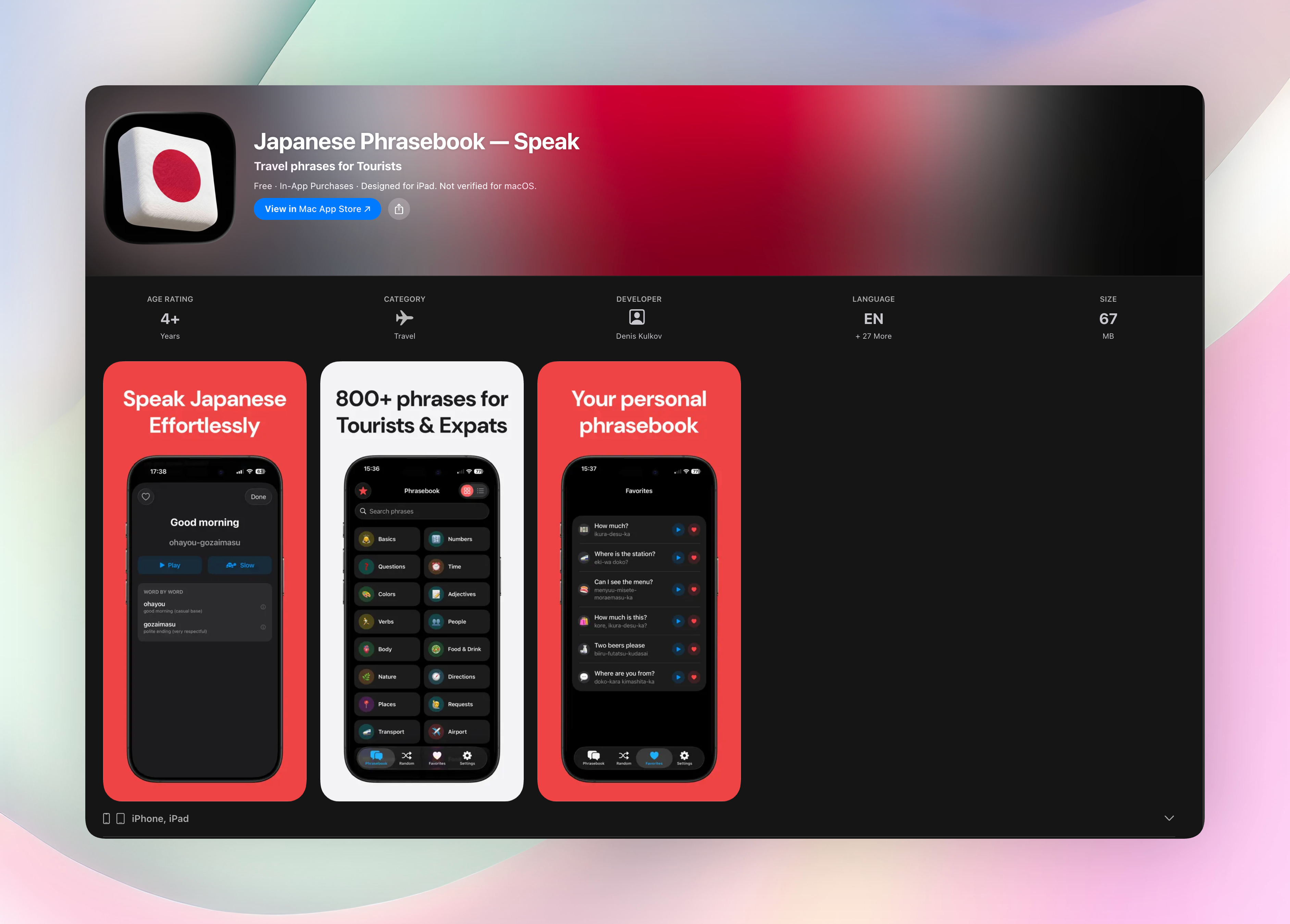
Reading the two columns off a page is one thing; hearing where the emphasis actually falls, or how fast gozaimasu gets said in practice, is another. Japanese Phrasebook is an offline app built around exactly that gap — real-world phrases by category, each with native audio at full and slow speed plus a word-by-word breakdown, so you can hear the casual and polite forms said properly instead of guessing from romaji alone.
A handful of travel-specific lines
A few more common japanese phrases that don't fit the categories above but come up constantly:
- Kore wa ikura desu ka? (これはいくらですか?) — How much is this?
- Toire wa doko desu ka? (トイレはどこですか?) — Where's the bathroom?
- Oishii (おいしい) — Delicious. Useful at a meal, and genuinely appreciated if you say it to whoever cooked.
- Kanpai (乾杯) — Cheers, said before the first sip of a drink shared with others.
- Itadakimasu (いただきます) — Said just before eating, roughly "I gratefully receive this." Not optional at a shared meal — it's closer to a habit than a phrase you can skip.
FAQ
What are the most essential Japanese phrases for a first trip?
Konnichiwa (hello), sumimasen (excuse me/sorry), arigatou gozaimasu (thank you), onegaishimasu (please), and eigo o hanasemasu ka (do you speak English). Those five get you through the most common situations — asking for help, being polite, and signaling you need English.
Is it rude to use casual Japanese with strangers?
It can land as overly familiar or even disrespectful, especially with someone older or in a service role. As a traveler, default to the polite forms — gozaimasu endings, sumimasen instead of gomen — with anyone you don't personally know.
Do I need to learn kanji to use basic Japanese phrases?
No. Every phrase above works fine read off romaji or hiragana, and most travel situations never require you to read kanji yourself — signage in tourist areas is usually bilingual, and menus increasingly have pictures or English subtitles.
What's the difference between arigatou and arigatou gozaimasu?
Arigatou is casual, used with friends and family. Arigatou gozaimasu is the polite, general-purpose version — safe with shopkeepers, hotel staff, and anyone you've just met. When unsure, add gozaimasu.
Is sumimasen the same as sorry?
Not exactly — sumimasen does double duty as "excuse me" (getting someone's attention) and a mild "sorry." For an apology about something that's genuinely your fault, gomennasai is the more personal choice; sumimasen still works and is never wrong, just slightly more distant.
Free Japanese Phrasebook tools
- Japanese Date ConverterConvert dates between the Gregorian calendar and Japan's modern Meiji, Taishō, Shōwa, Heisei, and Reiwa era notation.
- Japanese Greeting PickerPick a practical Japanese greeting for morning, daytime, evening, or night.
- Japanese Number ConverterConvert whole numbers between Arabic digits and Japanese numerals, with kanji, kana, and romaji readings for prices, quantities, and travel details.
- Konbini Phrase BuilderChoose what you need at a Japanese convenience store and get two ready-to-use phrases.
- Sumimasen Situation ChooserChoose a situation to see how sumimasen works and add a useful follow-up.