Japanese phrases for tourists
Japanese phrases for tourists cluster around four moments of an actual trip: getting through the airport and trains, paying at a shop or konbini, asking for help when you're lost, and the politeness words that carry you through all of it. Here's each, organized the way a trip actually unfolds.
At the airport and on trains
Train stations are where most first-day confusion happens, since signage moves fast and platforms change.
- Sumimasen, [station] eki wa doko desu ka? (すみません、[駅名]駅はどこですか?) — Excuse me, where is [station] station?
- Kore wa [destination] iki desu ka? (これは[行き先]行きですか?) — Is this [train] bound for [destination]? Iki (行き) attaches to the destination name and means "bound for," so you'll see it everywhere on platform signage too.
- Tsugi no densha wa nanji desu ka? (次の電車は何時ですか?) — What time is the next train?
- Chiketto o ichimai kudasai (チケットを一枚ください) — One ticket, please. Mai (枚) is the counter for flat things like tickets and paper — ichimai is "one," nimai is "two."
- Nanbansen desu ka? (何番線ですか?) — Which platform number? Handy at larger stations where several lines share one building.
- Nimotsu wa doko desu ka? (荷物はどこですか?) — Where is the luggage (claim)? Useful at the airport after landing, or when a hotel is holding your bags.
Station staff are generally used to helping travelers who don't speak Japanese, so leading with sumimasen and pointing at a map or destination name works even if the rest of the sentence doesn't come together.
At a konbini or shop
Convenience stores (konbini) run on a short, predictable script, and shopping elsewhere follows the same pattern.
- Kore o kudasai (これをください) — This one, please, said while pointing or handing over an item.
- Fukuro wa irimasen (袋は要りません) — I don't need a bag. Staff ask by default at most stores, and this is the polite way to decline without a flat "no."
- Kaado wa tsukaemasu ka? (カードは使えますか?) — Can I use a card? Worth asking outside major cities, where cash still gets used more.
- Atatamete moraemasu ka? (温めてもらえますか?) — Could you warm this up? Standard for a bento or rice ball at a konbini, where hot food gets heated on request.
Konbini in Japan cover far more than snacks — bill payment, ATMs that accept foreign cards, and hot food counters are all standard, so this short set of phrases ends up doing a lot of work across an entire trip, not just for a quick drink or onigiri.
At the hotel
Hotel check-in has its own short set of lines, and they're worth knowing before you're standing at the front desk after a long flight.
- Chekku in o onegaishimasu (チェックインをお願いします) — Check-in, please.
- Yoyaku shiteimasu (予約しています) — I have a reservation.
- Nanji made desu ka? (何時までですか?) — Until what time? Useful for checkout time, breakfast hours, or how late the front desk is staffed.
- Waifai wa arimasu ka? (ワイファイはありますか?) — Is there wifi? Wifi is a loanword, so waifai (ワイファイ) is how you'll hear and say it in Japanese, not an English pronunciation dropped into the sentence.
Asking for help when you're lost
- [Place] wa doko desu ka? ([場所]はどこですか?) — Where is [place]? Swap in toire (トイレ, bathroom), eki (駅, station), or basically any noun.
- Michi ni mayoimashita (道に迷いました) — I'm lost. A complete, useful sentence on its own — most people will either point you in the right direction or walk you partway there.
- Tasukete kudasai (助けてください) — Please help me. This is stronger than the phrases above and fits an actual emergency, not routine confusion about directions.
- Byouin wa doko desu ka? (病院はどこですか?) — Where is the hospital? Worth having ready even if you never need it — station staff, hotel staff, and konbini clerks can all usually point you toward the nearest one or call for help.
The politeness that ties it together
Every one of these scenarios runs on the same small set of words: sumimasen to open almost any interaction, onegaishimasu when you're making a request, and arigatou gozaimasu once you've gotten what you needed. If those three feel shaky, the full breakdown of sorry, excuse me, and please covers the nuance between them, and how to say thank you in Japanese covers the politeness ladder on the other end.
None of the phrases above require you to understand a fast reply — most transactions in Japan are short enough that pointing, a number, or a nod covers whatever comes back. The goal with japanese travel phrases isn't fluency; it's having the first line ready so the interaction starts smoothly, even if the rest of the exchange happens in gestures and goodwill.
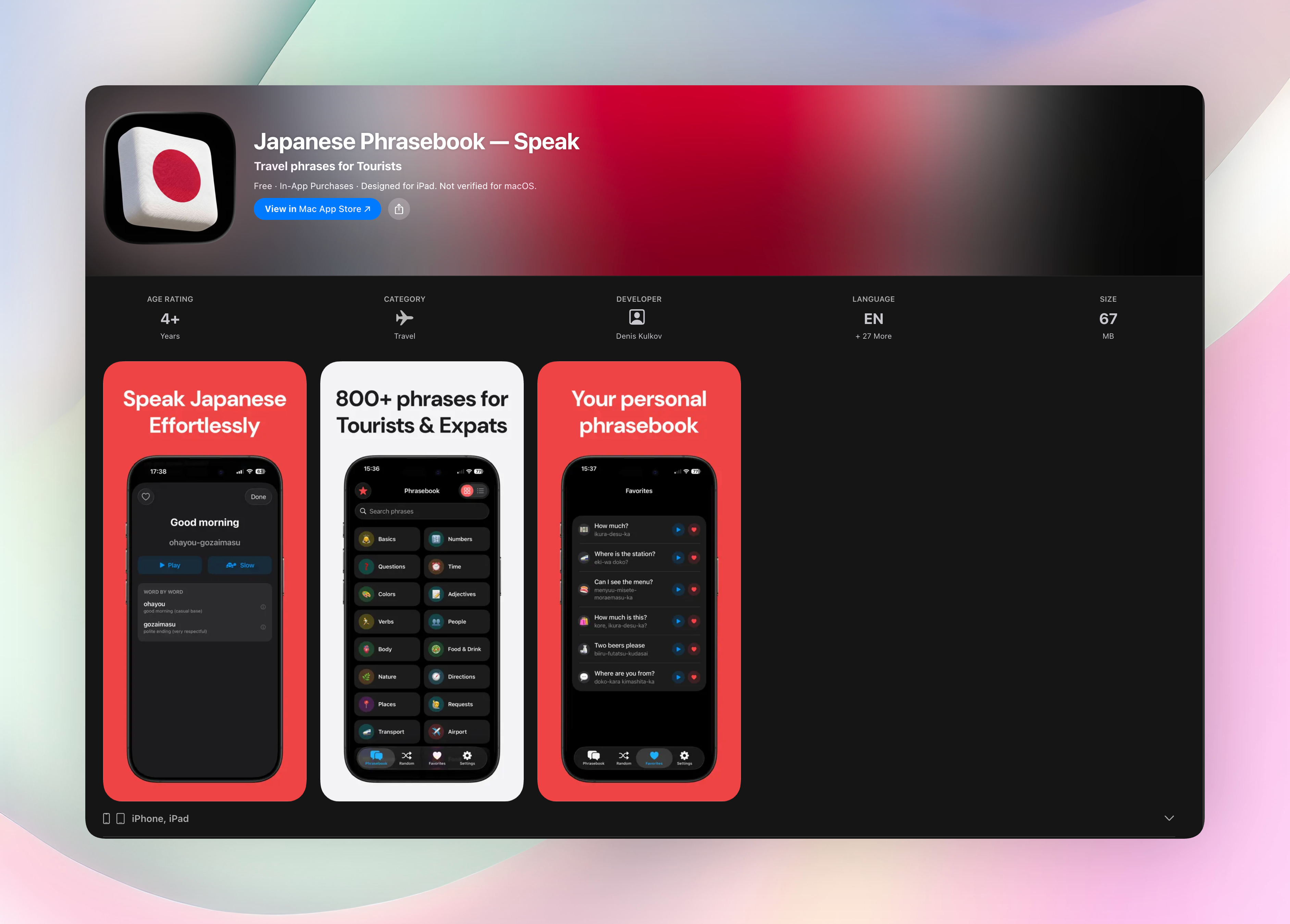
Hearing these said at normal speed — especially longer ones like atatamete moraemasu ka — makes a real difference over reading romaji cold. Japanese Phrasebook is an offline app with real-world Japanese phrases organized by category, including transport, food, and shopping, each with native audio at full and slow speed and a word-by-word breakdown, built for exactly these kinds of trip scenarios.
For the shorter, cornerstone list of everyday essentials, see basic Japanese phrases for travelers.
FAQ
What are the most useful Japanese phrases for tourists?
Sumimasen (excuse me/sorry), eigo o hanasemasu ka (do you speak English), kore o kudasai (this one, please), and ~wa doko desu ka (where is ~) cover the majority of tourist interactions — ordering, asking directions, and getting someone's attention.
Do train station staff in Japan speak English?
It varies a lot by station and city — major stations in Tokyo and Osaka usually have some English signage and staff, while smaller regional stations may not. Sumimasen plus pointing at a destination name works regardless.
How do you ask for a bag or decline one in Japanese?
Fukuro wa irimasen (袋は要りません) politely declines a bag; if you want one, fukuro o kudasai (袋をください) asks for it. Staff usually ask by default, so having the decline ready is more often useful.
Is it okay to just point and use simple Japanese phrases instead of full sentences?
Yes — pointing plus kore o kudasai ("this one, please") or a single noun plus wa doko desu ka ("where is") is completely normal and gets understood everywhere. Full grammatical sentences aren't expected from a visitor.
What Japanese phrases are most useful for a hotel check-in?
Chekku in o onegaishimasu (check-in, please) and yoyaku shiteimasu (I have a reservation) cover the actual check-in. Nanji made desu ka (until what time?) is worth adding for checkout and breakfast hours once you're settled in.
Free Japanese Phrasebook tools
- Japanese Date ConverterConvert dates between the Gregorian calendar and Japan's modern Meiji, Taishō, Shōwa, Heisei, and Reiwa era notation.
- Japanese Greeting PickerPick a practical Japanese greeting for morning, daytime, evening, or night.
- Japanese Number ConverterConvert whole numbers between Arabic digits and Japanese numerals, with kanji, kana, and romaji readings for prices, quantities, and travel details.
- Konbini Phrase BuilderChoose what you need at a Japanese convenience store and get two ready-to-use phrases.
- Sumimasen Situation ChooserChoose a situation to see how sumimasen works and add a useful follow-up.