
How to say do you speak English in Japanese
To ask do you speak English in Japanese, say eigo o hanasemasu ka (英語を話せますか). It's one of a small set of survival phrases — alongside asking a price, finding a bathroom, and signaling confusion — that get you unstuck fast when you're lost, rushed, or not understood.
How to say "do you speak English" in Japanese
Eigo o hanasemasu ka? (英語を話せますか?) literally asks "can you speak English?" It's the direct, standard version, and a completely normal question to lead with — plenty of people in tourist areas, hotels, and stations do speak some English, and asking upfront saves both sides time. If the answer is no, a slow nod and simple words usually still get you through the interaction; sumimasen (すみません, "excuse me") plus pointing covers a lot of ground on its own.
How much is this in Japanese
Kore wa ikura desu ka? (これはいくらですか?) — how much is this — is one of the most useful phrases for a trip, whether at a shop, a market stall, or a restaurant without visible prices. Kore (これ, "this") swaps easily: sore (それ) for something near the other person, are (あれ) for something farther away from both of you, so the same sentence structure covers almost any pointing situation.
Most transactions don't actually require you to understand the spoken answer — prices in Japan are shown on a register display or written down constantly, so asking the question is often enough even if the reply comes back too fast to follow.
Recognizing the reply helps too, and Japanese counts large numbers differently than English does. Instead of grouping by thousands, it groups by ten-thousands: hyaku (百) is 100, sen (千) is 1,000, and man (万) is 10,000. A price of ¥15,000 is read as ichiman gosen en (一万五千円) — "one-ten-thousand, five-thousand yen" — not "fifteen thousand." You don't need to do the math in your head; just recognizing sen versus man in a spoken price tells you roughly what range you're in, which is often all you need before glancing at the register display to confirm.
Where is the bathroom in Japanese
Toire wa doko desu ka? (トイレはどこですか?) — where is the bathroom — is worth memorizing cold, since it's one of the few phrases you'll need on short notice. Toire (トイレ) is the everyday word; a more formal alternative you'll see on signage is o-tearai (お手洗い). Both are understood everywhere, and the doko desu ka ("where is") pattern behind it works for any noun — eki (駅, station), konbini (コンビニ), or byouin (病院, hospital).
How to say I understand and I don't understand in Japanese
Wakarimasu (わかります) means "I understand," as a general statement, and wakarimashita (わかりました) — past tense — is what you say to acknowledge something just explained to you, closer to "got it" or "understood." Wakarimasen (わかりません) is "I don't understand," and it's genuinely one of the most useful phrases on this list: it tells the other person clearly that you need a different approach, rather than leaving them guessing why you're not responding.
Pairing wakarimasen with a small apologetic gesture and sumimasen softens it — sumimasen, wakarimasen ("sorry, I don't understand") reads as polite rather than abrupt.
When you need something repeated or slower
Two follow-up phrases pair naturally with wakarimasen:
- Mou ichido onegaishimasu (もう一度お願いします) — One more time, please.
- Yukkuri hanashite kudasai (ゆっくり話してください) — Please speak slowly.
Between these and wakarimasen, you've got a full loop: signal confusion, ask for a repeat or a slower pace, and try again. It's a small toolkit, but it covers the moments where a conversation would otherwise stall completely — and knowing all three cold means you're never stuck with nothing to say.
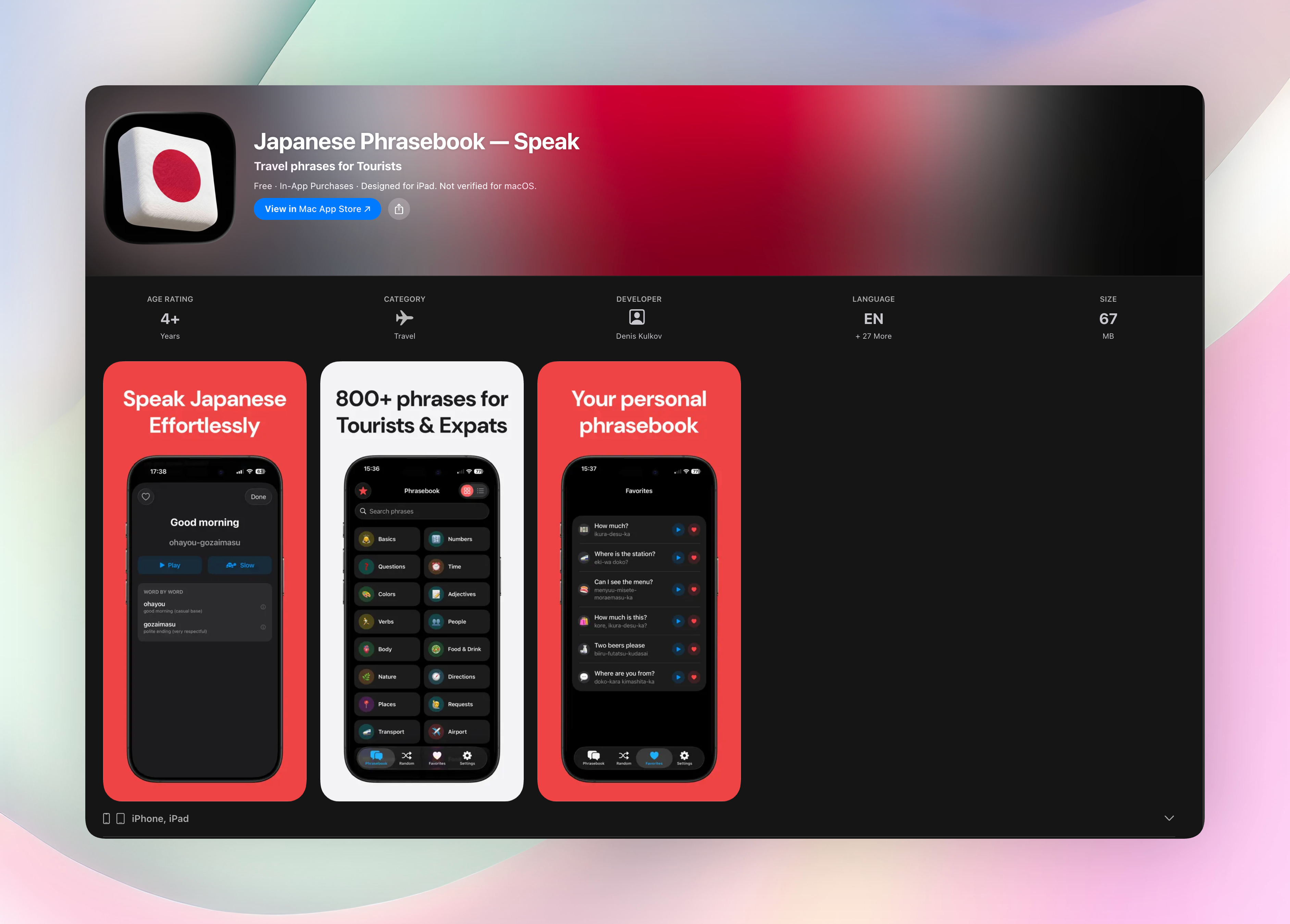
Reading these phrases is one thing; recognizing them at conversational speed when someone actually says them back to you is the harder skill. Japanese Phrasebook is an offline app with real-world Japanese phrases organized by category, each with native audio at full and slow speed, so you can train your ear on exactly this kind of exchange before you're relying on it mid-conversation.
These pair with the rest of the basic Japanese phrases for travelers, and if you're mapping out phrases by scenario, Japanese phrases for tourists covers airport, shop, and hotel situations in more detail.
FAQ
How do you politely ask if someone speaks English in Japanese?
Eigo o hanasemasu ka? (英語を話せますか?) is the standard, polite phrasing. It's a normal, expected question in tourist areas and doesn't come across as rude or presumptuous.
What's the difference between wakarimasu and wakarimashita?
Wakarimasu is present tense, "I understand," used as a general statement. Wakarimashita is past tense, used to acknowledge that you just understood something someone explained — closer to "got it" than an ongoing state.
Is there a polite way to say I don't understand in Japanese?
Wakarimasen (わかりません) on its own is fine and not rude. Pairing it with sumimasen — sumimasen, wakarimasen — softens it further and is a natural, polite way to signal confusion.
What should I say if someone is speaking too fast for me to follow?
Yukkuri hanashite kudasai (ゆっくり話してください), "please speak slowly," is the direct request. Mou ichido onegaishimasu ("one more time, please") works if you just need the sentence repeated rather than slowed down.
How do I recognize a large price in spoken Japanese?
Listen for sen (千, thousand) and man (万, ten-thousand) rather than trying to translate the whole number. Japanese groups digits by ten-thousands, not thousands, so a price with man in it is already in four-digit territory or higher.
Free Japanese Phrasebook tools
- Japanese Date ConverterConvert dates between the Gregorian calendar and Japan's modern Meiji, Taishō, Shōwa, Heisei, and Reiwa era notation.
- Japanese Greeting PickerPick a practical Japanese greeting for morning, daytime, evening, or night.
- Japanese Number ConverterConvert whole numbers between Arabic digits and Japanese numerals, with kanji, kana, and romaji readings for prices, quantities, and travel details.
- Konbini Phrase BuilderChoose what you need at a Japanese convenience store and get two ready-to-use phrases.
- Sumimasen Situation ChooserChoose a situation to see how sumimasen works and add a useful follow-up.