How to say no in Japanese
The direct word for no in Japanese is iie (いいえ), and yes is hai (はい). In practice, Japanese speakers avoid a flat iie far more than English speakers avoid a flat "no" — softer phrases like chotto... or daijoubu desu do the job instead in most everyday situations.
Hai and iie: the basic pair
Hai (はい) is yes, and iie (いいえ) is no. They're correct, they're understood everywhere, and you can absolutely use them — a shop clerk asking a direct yes/no question, or a straightforward question from a friend, doesn't need any softening.
One thing worth knowing about hai specifically: it doesn't always mean agreement. In conversation, Japanese speakers say hai (or the more casual un, うん) constantly just to show they're listening — closer to "uh-huh" or a nod than an actual "yes." If someone's rattling off hai while you're explaining something, they're probably tracking along, not necessarily agreeing with everything you say.
Why a flat "no" gets avoided
Where Japanese really diverges from English is in refusing or declining something. A direct iie can come across as blunt or even confrontational in a lot of everyday situations — turning down an invitation, declining an offer, disagreeing with a suggestion — so native speakers reach for something softer almost automatically.
The most common of these is trailing off: chotto... (ちょっと..., "a little...") left unfinished, often paired with an apologetic sumimasen. "Sumimasen, chotto..." said with a slight wince and no actual sentence completed is instantly understood as "no, but I don't want to say it directly." It sounds vague on paper; in context, it's completely clear.
Two ways to decline politely
Daijoubu desu (大丈夫です) literally means "it's fine" or "I'm okay," and it's the standard way to decline something offered — a bag at a checkout counter, a refill, help you don't need. Said with a small hand wave, it's understood as "no thank you" without ever using the word no.
Kekkou desu (結構です) works similarly — "that's fine as it is" or "no thank you" — but it's a touch more formal and can land as a bit cold or final if the tone isn't right. Daijoubu desu is the safer default for a traveler in most casual situations; kekkou desu fits better in a more formal exchange, like turning down an upsell at a hotel.
Putting it together
If a shopkeeper asks if you want a receipt and you don't, "daijoubu desu" (with a small shake of the head) is more natural than "iie." If a friend invites you somewhere you can't make it to, "sumimasen, chotto..." leaves it politely unresolved rather than a hard refusal. Iie itself is still correct and worth knowing — it's just not the tool reached for as often as the direct translation suggests.
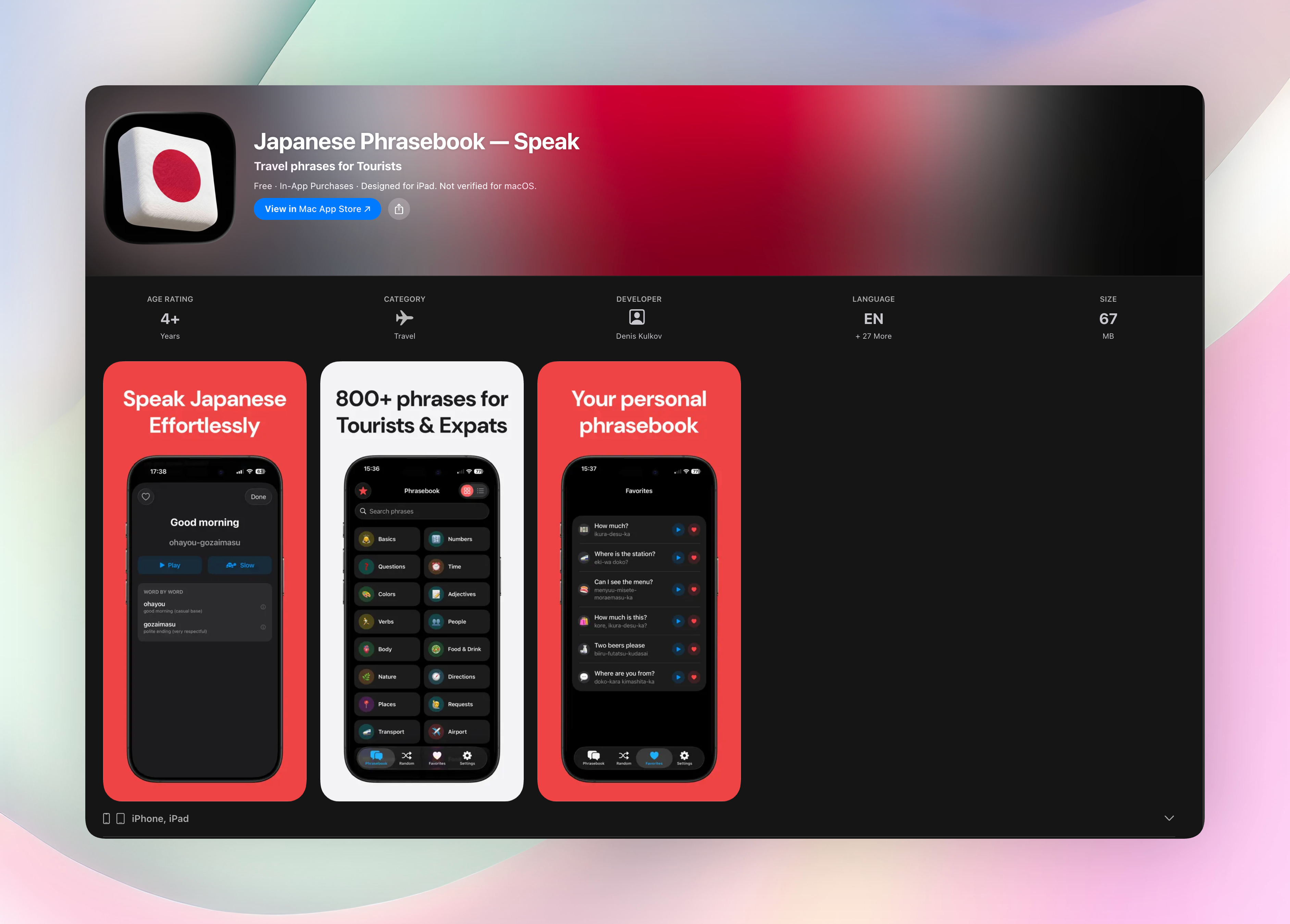
The tone here matters as much as the words — daijoubu desu said flatly versus said gently can read differently, and that's hard to pick up from text alone. Japanese Phrasebook is an offline app with real-world Japanese phrases organized by category, each with native audio at full and slow speed, so you can hear how a polite decline is actually supposed to sound.
More everyday phrases like these are collected in the basic Japanese phrases for travelers guide.
FAQ
Is it rude to say iie in Japanese?
Not rude exactly, but it can sound more blunt or final than intended in casual conversation, where softer phrasing is the norm. It's completely fine in direct yes/no situations, like confirming a simple fact.
What's the polite way to say no thank you in Japanese?
Daijoubu desu (大丈夫です) is the most common way to decline something offered — a bag, a refill, an upgrade. Kekkou desu (結構です) works too but is more formal and can sound a little curt if the tone isn't soft.
Does hai always mean yes in Japanese?
Not necessarily — it's also used constantly as a verbal acknowledgment while listening, similar to "uh-huh" in English, without implying full agreement. Context usually makes clear which one is meant.
Why do Japanese speakers trail off instead of saying no directly?
It's a way of declining without confrontation. A phrase like "sumimasen, chotto..." left unfinished is understood as a soft no, and letting the sentence trail off is itself part of the message rather than an accident.
Free Japanese Phrasebook tools
- Japanese Date ConverterConvert dates between the Gregorian calendar and Japan's modern Meiji, Taishō, Shōwa, Heisei, and Reiwa era notation.
- Japanese Greeting PickerPick a practical Japanese greeting for morning, daytime, evening, or night.
- Japanese Number ConverterConvert whole numbers between Arabic digits and Japanese numerals, with kanji, kana, and romaji readings for prices, quantities, and travel details.
- Konbini Phrase BuilderChoose what you need at a Japanese convenience store and get two ready-to-use phrases.
- Sumimasen Situation ChooserChoose a situation to see how sumimasen works and add a useful follow-up.