How to say I love you in Japanese
The direct translation of "I love you" is aishiteru (愛してる), but Japanese speakers rarely say it out loud. In daily life, suki desu (好きです, "I like you") and daisuki desu (大好きです, "I really like you") do most of the work that "I love you" does in English.
Suki desu: the phrase that actually starts relationships
Suki desu (好きです) literally means "I like you," but in a romantic context it carries real weight — it's the phrase people use to confess feelings and, often, to ask someone out. Japan has a fairly established tradition around this called kokuhaku (告白), a deliberate, spoken confession that usually happens before a couple starts officially dating, rather than feelings building up unspoken over time. A typical kokuhaku line is suki desu, followed by tsukiatte kudasai (付き合ってください) — "please go out with me."
Because English doesn't really have an equivalent to "I like you" as a serious romantic declaration — in English it can sound like a step down from "I love you" — this is the phrase that trips people up most. In Japanese, it isn't a lesser statement; it's often the whole confession.
Daisuki desu: a stronger, still-common step up
Daisuki desu (大好きです) adds dai (大, "big/great") to suki, so it reads as "I really like you" or, in a relationship, closer to "I love you." It's common between couples and still gets said in everyday conversation without sounding heavy or overly dramatic.
One thing worth knowing: daisuki isn't exclusively romantic. Japanese speakers use it for close friends, family, pets, and things they genuinely love — a favorite food, a hobby, a band. Context and tone tell you which one's meant; said to a partner, it reads as affection, not confusion.
Aishiteru: real, but rarer than the phrasebook implies
Aishiteru (愛してる) comes from the verb aisuru (愛する, "to love") and is the most literal match for "I love you." The polite form is aishite imasu (愛しています).
It exists and gets used, but it's a heavier, more dramatic statement than suki or daisuki — closer to the weight "I love you" carries when someone says it for the very first time in English, rather than something said casually or often. You'll hear it in songs, films, and dramatic scenes more than in everyday conversation between real couples, where suki desu and daisuki desu tend to cover the same emotional ground without sounding like a big declaration every time. That doesn't mean it's never said between real couples — just that it's not the default the way "I love you" is in English.
How to say "love you" or "love u" casually
If you're looking for the casual, text-message version of "love you" — the kind of thing you'd send without much ceremony — daisuki is closer to that register than aishiteru, which tends to read as more formal or intense even in writing. A short suki or daisuki, sometimes with no desu at all in a very casual text between partners, functions the way a quick "love you" text does in English.
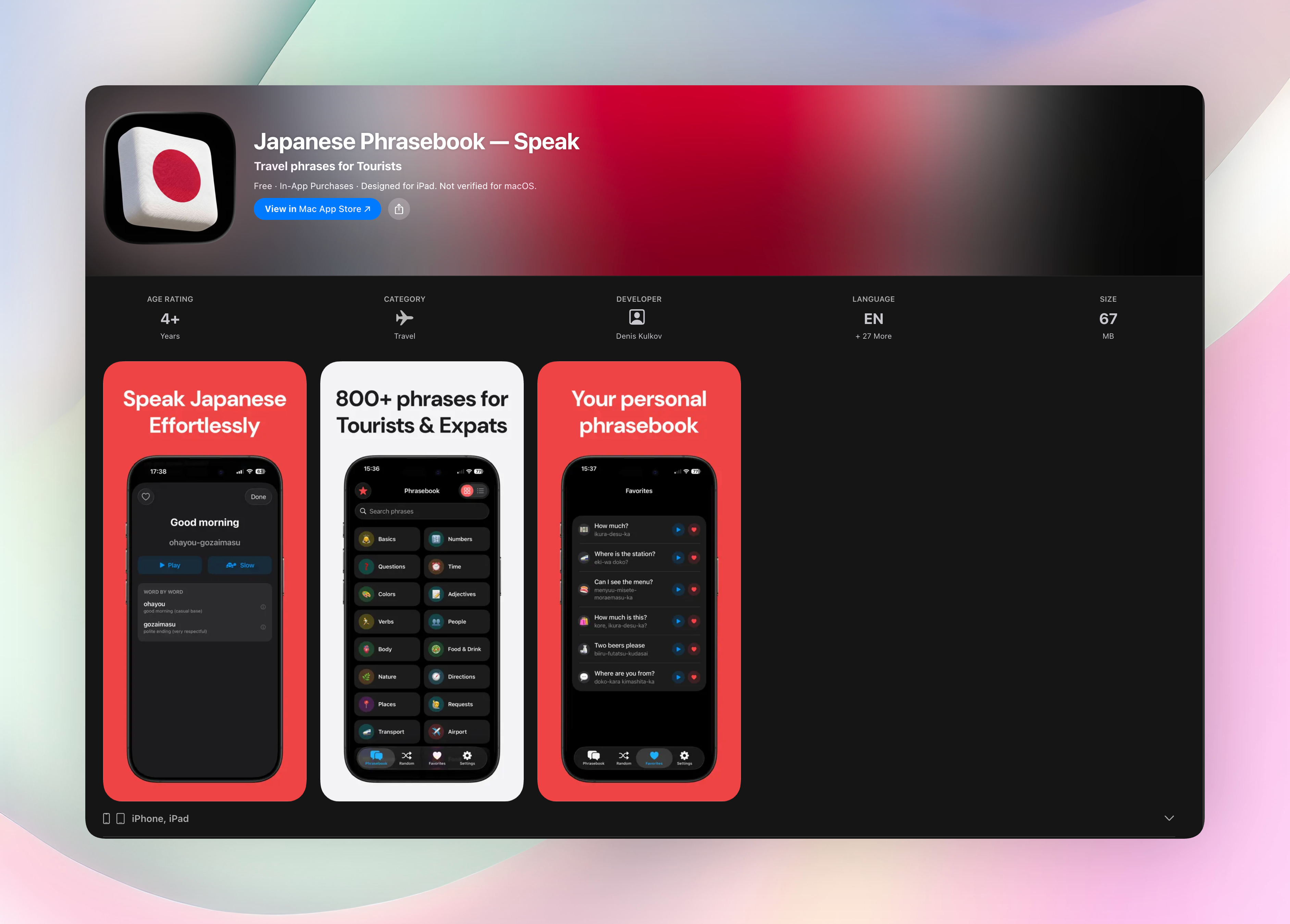
Getting the register right matters more here than with almost any other phrase — the same words said flatly versus warmly land very differently. Japanese Phrasebook is an offline app with real-world Japanese phrases organized by category, each with native audio at full and slow speed, so you can hear how suki desu and daisuki actually sound spoken rather than guessing the tone from text alone.
FAQ
What's the difference between suki and daisuki in Japanese?
Suki (好き) means "like," and daisuki (大好き) — "big like" — means "really like" or, in the right context, "love." Both get used romantically; daisuki is the stronger of the two, but neither is exclusively romantic on its own — tone and context decide.
Is aishiteru too strong to say to a partner?
Not too strong to be wrong, just heavier than how it's actually used day to day. Japanese couples say suki desu or daisuki desu far more often; aishiteru tends to be reserved for a genuinely big, serious moment rather than casual daily affection.
How do you say "I love you" to a friend or family member in Japanese?
Daisuki (大好き) works for platonic love too — a parent, a sibling, a close friend. Aishiteru is specifically romantic and wouldn't fit a friendship or family context; using it there would sound out of place.
Why does suki desu mean more in Japanese than "I like you" does in English?
Because Japanese doesn't rely on "I love you" as the default relationship-starting phrase the way English does. Suki desu is commonly the confession itself — the phrase used in kokuhaku, the tradition of stating your feelings before a relationship starts — so it carries romantic weight English speakers might not expect from a literal translation.
Free Japanese Phrasebook tools
- Japanese Date ConverterConvert dates between the Gregorian calendar and Japan's modern Meiji, Taishō, Shōwa, Heisei, and Reiwa era notation.
- Japanese Greeting PickerPick a practical Japanese greeting for morning, daytime, evening, or night.
- Japanese Number ConverterConvert whole numbers between Arabic digits and Japanese numerals, with kanji, kana, and romaji readings for prices, quantities, and travel details.
- Konbini Phrase BuilderChoose what you need at a Japanese convenience store and get two ready-to-use phrases.
- Sumimasen Situation ChooserChoose a situation to see how sumimasen works and add a useful follow-up.