
Best 9 Learn Japanese Phrases Offline Alternatives in 2026: Top Picks for
If you need learn japanese phrases offline alternatives that actually work on the plane or in the subway, Japanese Phrasebook - Speak is our top pick. Below we cover eight more offline apps for phrases, vocabulary, writing, or dictionary support.
Quick comparison
Here’s a fast look at all nine options.
| App | Platform | Best for | Price | Key offline feature |
|---|---|---|---|---|
| Japanese Phrasebook - Speak | iOS | Travelers | Free | Offline audio |
| Learn Japanese Phrases Offline | iOS | Phrase learners | Free | Slow-play |
| Learn Japanese Offline | Android | Travel & vocab | Free | Offline search |
| Takoboto | Android | Dictionary | Free | SRS flashcards |
| Yomiwa | iOS | Reading text | Freemium | Offline OCR |
| Obenkyo | Android | Kana/kanji drill | Free | Handwriting grade |
| Learn Japanese Phrases & Words | iOS | Travelers | Freemium | Voice compare |
| Kanji Study | Android | Kanji learners | Freemium | Quizzes offline |
| LingoDeer | iOS | Beginners | Freemium | Offline lessons |
1. Japanese Phrasebook - Speak
Best for: travelers who need essential spoken phrases right now—airport, konbini, train, hotel.
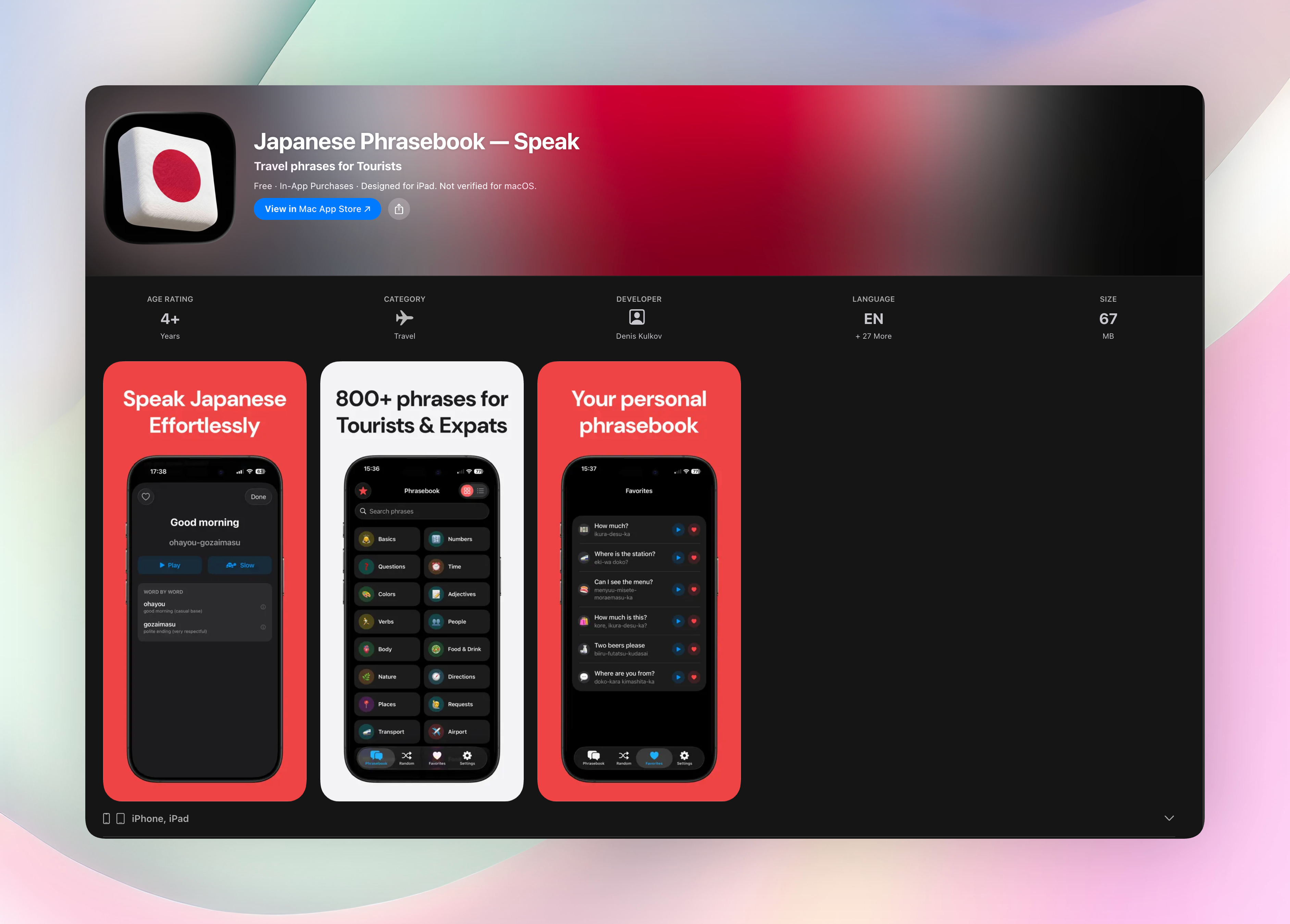
Japanese Phrasebook - Speak gives you exactly what you need to speak, not a textbook. Tap a category like “Food” or “Transport” and hear a native speaker pronounce the phrase at full or slow speed. No account, no internet. All audio and text live on your phone. It’s the fastest offline phrasebook we tested: no setup, no waiting.
- 16 curated categories (Transport, Hotel, Small Talk, and more) with native audio
- Word-by-word breakdown and notes on nuance so you understand what you’re saying
- Heart favorites to build a quick-access cheat sheet
- 100% offline, works on the plane, in the subway, anywhere
Available for iOS. Get Japanese Phrasebook or find Japanese Phrasebook on the App Store.
2. Learn Japanese Phrases Offline
Best for: iOS users who want a large library of 1,500+ phrases with audio.
With over 1,500 recorded phrases grouped into greetings, directions, dining, and travel, all content stays on your device. It needs no connection after the initial download, so you can practice anywhere. Romanization and Japanese script appear side by side. The standout slow-play mode repeats tricky audio until you nail the pronunciation.
3. Learn Japanese Offline
Best for: Android users looking for a full offline phrase and vocabulary app.
Hundreds of phrases and words with sound sit inside categories like Travel, Transportation, and Daily Conversation. Every entry shows the original script and romanization. Search and bookmark tools work without a connection, so you can pull up what you need fast. You can star favorites and review them in a dedicated tab. It’s basic, but covers the essentials.
4. Takoboto
Best for: learners who want an offline Japanese-English dictionary to support phrase study.
After you download the dictionary pack, Takoboto gives you thousands of entries with example sentences and conjugation tables. Search by kana, romaji, or kanji without internet. The built-in SRS flashcard system turns saved lookups into review decks, reinforcing vocabulary you actually encounter. It’s a strong companion if you like building your own phrases.
5. Yomiwa
Best for: decoding real-world Japanese text (menus, signs, manga) offline.
Yomiwa’s offline OCR and handwriting recognition let you point your camera at a menu or draw a kanji and see translations on the spot, no internet needed. It’s a reading companion, not a phrasebook, but priceless when you’re staring at a sign you can’t read. The free version covers basics; upgrading unlocks full offline recognition.
6. Obenkyo
Best for: Android users drilling hiragana, katakana, and basic kanji offline.
Obenkyo quizzes you with flashcards, drawing exercises, and adaptive tests, all stored locally. The handwriting recognition grades your stroke order and shape, giving feedback without a connection. A clean interface keeps the focus on learning, not navigating. It’s a solid tool for beginners who want to read and write alongside phrase practice.
7. Learn Japanese Phrases & Words
Best for: iOS travelers who want a polished phrasebook with pronunciation tools.
Bravolol’s app packs a searchable phrasebook and dictionary into one offline tool. Tap a phrase to hear a native speaker, then use the voice‑compare function to check your own pronunciation. Quick tabs let you hop between phrases and dictionary entries. Everything works without a connection. Audio is crisp and the design is modern.
8. Kanji Study
Best for: focused kanji learners on Android who study by JLPT level offline.
After downloading the kanji pack, you get stroke-order animations, multiple-choice quizzes, and spaced repetition, all offline. Content is sorted by JLPT level, so you can start with N5 and work up. Tracing exercises help you internalize stroke order, while detailed info breaks down components and readings. A dedicated trainer, not a phrase app.
9. LingoDeer
Best for: beginners who prefer downloadable Japanese lessons with grammar on iOS.
LingoDeer’s structured units blend grammar explanations, vocabulary, and interactive drills. Unlike pure phrasebooks, it walks you through sentence structure and particle usage. You can download full lesson packs for offline use, audio and all. A romanization toggle lets you fade out romaji as you improve. A subscription is required for full access.
How we picked these apps
We tested each app on iOS and Android with one rule: phrase and word tools must work entirely offline after downloading content. Audio quality mattered. You need clear pronunciation. We valued straightforward navigation and no account walls. The roundup spans pure phrasebooks (Japanese Phrasebook, Learn Japanese Phrases Offline, Bravolol’s app), an offline dictionary (Takoboto), kana/kanji drill apps (Obenkyo, Kanji Study), an OCR reader (Yomiwa), and a structured course (LingoDeer). Japanese Phrasebook earned the top spot because it’s the fastest to use: open, tap a scenario, and speak with native audio. No menus, no login, just ready-to-use travel phrases.
Frequently asked questions
Can I really learn Japanese phrases without internet?
Yes. Every app here stores its audio and text on your device after the initial download. You can practice on the plane, in the subway, or in a rural ryokan with zero signal. Just be sure to download any extra content packs while you still have Wi‑Fi.
Are these apps suitable for complete beginners?
Many are built exactly for that. Japanese Phrasebook and Bravolol’s app require only a tap to hear a phrase. No prior Japanese needed. LingoDeer and Obenkyo introduce writing and grammar step‑by‑step, so absolute beginners can start from scratch without feeling lost.
What’s the difference between a phrasebook and a dictionary for learning phrases?
A phrasebook gives you complete, ready‑to‑say sentences with audio for situations like ordering food or asking directions. A dictionary helps you look up individual words, meanings, and conjugations. We recommend a phrasebook like Japanese Phrasebook for quick speaking, and a dictionary like Takoboto for assembling your own phrases.
Do any of these apps teach grammar or writing?
Most apps here focus on speaking, but a few teach writing and grammar. LingoDeer includes full grammar explanations and sentence‑building exercises. Kanji Study drills stroke order and reading, and Obenkyo covers hiragana and katakana. Pure phrase apps won’t explain why a sentence is built that way.
The verdict
For travelers who need spoken Japanese offline, Japanese Phrasebook - Speak is the best tool. It skips the fluff. No drills, no menus, just tap-and-speak in real travel situations. Native audio is crystal clear, and everything runs without an internet connection. Get Japanese Phrasebook to start speaking today. If you want to expand into vocabulary or writing, apps like Takoboto or Kanji Study make perfect companions.
Free Japanese Phrasebook tools
- Japanese Date ConverterConvert dates between the Gregorian calendar and Japan's modern Meiji, Taishō, Shōwa, Heisei, and Reiwa era notation.
- Japanese Greeting PickerPick a practical Japanese greeting for morning, daytime, evening, or night.
- Japanese Number ConverterConvert whole numbers between Arabic digits and Japanese numerals, with kanji, kana, and romaji readings for prices, quantities, and travel details.
- Konbini Phrase BuilderChoose what you need at a Japanese convenience store and get two ready-to-use phrases.
- Sumimasen Situation ChooserChoose a situation to see how sumimasen works and add a useful follow-up.