
Best 9 Learn Japanese Daily Phrases Alternatives in 2026: Apps That Go Deeper
For a clean way to pick up the Japanese you’ll actually use, Japanese Phrasebook is the best tool. If you’re looking for learn japanese daily phrases alternatives, this list covers nine apps that focus on real-world expressions — from structured courses to audio-first tools.
Quick comparison
| App | Best for | Platform | Price |
|---|---|---|---|
| Japanese Phrasebook: Speak | Phrase-first travelers who want zero clutter | iOS | Paid |
| Duolingo | Bite-sized daily habit with streaks | iOS, Android | Freemium |
| LingoDeer | Structured Asian-language courses with grammar | iOS, Android | Freemium |
| Drops | Visual micro-sessions to build vocabulary fast | iOS, Android | Freemium |
| Memrise | Hearing real native speakers in short clips | iOS, Android | Freemium |
| Busuu | Getting feedback on your speaking and writing | iOS, Android | Freemium |
| Pimsleur | Hands-free audio lessons for immediate recall | iOS, Android | Paid |
| JA Sensei | Android-exclusive all-in-one phrasebook and grammar | Android | Freemium |
| Shirabe Jisho | Offline dictionary with rich example sentences | iOS | Freemium |
Japanese Phrasebook is the top pick for phrase-first learners who want to speak useful daily Japanese without distractions.
1. Japanese Phrasebook: Speak
Best for: travelers and commuters who need essential phrases fast, without fluff.
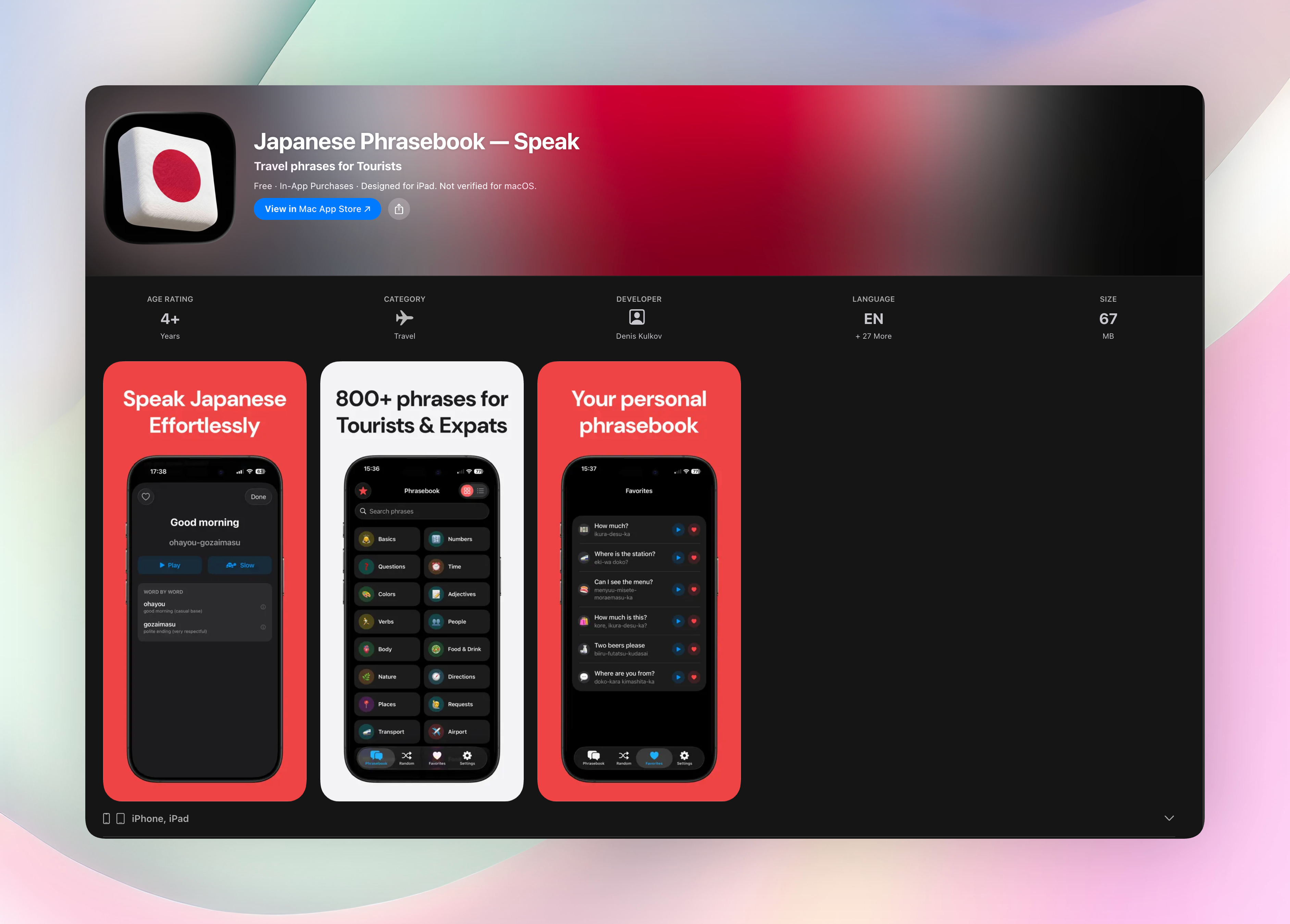
This app gives you only the phrases you’ll actually use at the airport, konbini, train station, or hotel. No grammar drills, no games, no account setup. You get clean categories, native audio, and a speak feature that helps you nail pronunciation.
- 16 real-world categories like Transport, Food, Hotel, Dating, and Small Talk
- Tap any phrase to hear it at natural or slow speed
- Word-by-word breakdowns with teaching notes to explain nuance
- Heart favorites for a personal quick-reference list
- Fully offline — no login, no internet needed
It’s the only app in this guide that gets a direct download link. Get it here: Get Japanese Phrasebook or Japanese Phrasebook on the App Store.
2. Duolingo: Language Lessons
Best for: casual learners who want bite-sized daily phrase practice backed by spaced repetition.
Duolingo makes learning feel like a quick game. Short sessions mix vocabulary, listening, and speaking, and the streak counter helps you turn practice into a daily habit. It won’t replace a dedicated phrasebook, but it’s a solid sidekick if you want a few minutes of practice each day.
3. LingoDeer - Learn Languages
Best for: learners who want structured Japanese courses with grammar notes that show you how phrases are built.
LingoDeer specializes in Asian languages and includes clear grammar breakdowns inside every lesson. Native-speaker audio helps you catch the flow of everyday expressions. The step-by-step path works well if you like understanding why a phrase is put together a certain way, not just memorizing it.
4. Drops: Language Learning
Best for: visual learners who want to build phrases quickly in five-minute daily sessions.
Drops uses swipe-based mini-games and bold illustrations to teach practical words and expressions. It leans on visual association instead of translation drills. Use it as a daily top-up to grow your phrase bank without feeling like you’re studying.
5. Memrise: Speak a new language
Best for: hearing authentic, real-world phrases from native speakers in context.
Memrise pairs short video clips of locals with spaced-repetition flashcards. You hear how everyday expressions actually sound, with the rhythm and intonation you’d miss in a textbook. That makes it especially useful for picking up natural phrases, not stiff classroom Japanese.
6. Busuu: Language Learning
Best for: getting feedback on your spoken and written phrases from native speakers.
Busuu combines vocabulary and grammar lessons with a community feature that lets native speakers correct your exercises. You can send a short audio recording or written sentence and get feedback that polishes your daily phrases. The structured path takes you from basics to usable conversation step by step.
7. Pimsleur: Learn a Language
Best for: audio-focused learners who want to start speaking daily phrases right away.
Each 30-minute core lesson is built around conversation and listening. You’re prompted to respond by voice, which is perfect for hands-free practice during commutes. It needs almost no screen time and pushes you straight into speaking, making it a strong companion when you can’t stare at a phone.
8. JA Sensei - Learn Japanese
Best for: Android users who want an all-in-one phrasebook, vocabulary, and grammar tool.
JA Sensei packs a deep phrasebook, interactive quizzes, and audio tracks into a single app. It’s Android-exclusive and works well offline. You can jump between everyday phrases, kanji, and grammar whenever you want. Self-directed learners often find it fits their pick-and-choose style.
9. Shirabe Jisho
Best for: iOS users who need an offline dictionary with rich example sentences for phrase context.
Shirabe Jisho is a powerful reference, not a course. Its offline search pulls hundreds of example sentences that show how words and phrases are used naturally. Pair it with a phrasebook like Japanese Phrasebook, and you’ll quickly understand the context behind the expressions you’re learning.
How we picked these apps
We looked for apps that teach daily Japanese phrases, not academic grammar or heavy kanji drills. Each one had to focus on high-frequency, real-world expressions and offer native audio. We favored clean structure, little clutter, and clear speaking or listening features. Apps that buried practical conversation under layers of complexity or game mechanics didn’t make the cut. We also made sure there are solid choices for both iOS and Android users.
Can I learn daily phrases with a free app?
Yes, free apps like Duolingo and Drops work well for building a phrase habit. But the most focused phrase tools (like Japanese Phrasebook) usually cost a little because they skip ads and don’t ask you to create an account.
Which app is best for speaking practice?
Pimsleur pushes you to speak from the first lesson with almost no screen time, while Japanese Phrasebook gives you instant tap-to-play audio and a pronunciation tool. Pairing a phrasebook with audio-focused practice speeds up your results.
Do I need an internet connection?
Several apps work entirely offline. Shirabe Jisho and JA Sensei both run without a connection, and Japanese Phrasebook needs no account and works offline from the start.
The verdict
Japanese Phrasebook is still the most direct tool for getting daily Japanese phrases into your ears and mouth, with no detours or fluff. Duolingo helps with habit-building, LingoDeer is great for grammar, and Pimsleur works well for hands-free audio. But if you just want usable phrases right now, grab Japanese Phrasebook: Japanese Phrasebook on the App Store.
Free Japanese Phrasebook tools
- Japanese Date ConverterConvert dates between the Gregorian calendar and Japan's modern Meiji, Taishō, Shōwa, Heisei, and Reiwa era notation.
- Japanese Greeting PickerPick a practical Japanese greeting for morning, daytime, evening, or night.
- Japanese Number ConverterConvert whole numbers between Arabic digits and Japanese numerals, with kanji, kana, and romaji readings for prices, quantities, and travel details.
- Konbini Phrase BuilderChoose what you need at a Japanese convenience store and get two ready-to-use phrases.
- Sumimasen Situation ChooserChoose a situation to see how sumimasen works and add a useful follow-up.