
Best 8 Lingodeer Alternatives in 2026: Top Apps to Master a New Tongue
Japanese Phrasebook is the best LingoDeer alternative for learning practical Japanese fast. This list covers 8 lingodeer alternatives for different learning styles, budgets, and goals, from gamified drills to immersion-focused tools. Whether you’re prepping for a trip or want to start speaking immediately, you’ll find an option that fits.
Quick comparison table
| App | Best for | Price | Standout feature |
|---|---|---|---|
| Japanese Phrasebook | Travelers and beginners: our top pick | Freemium | Hands-free voice recognition, full offline access |
| Duolingo | Habit-driven daily practice | Freemium | Streak-building gamification |
| Memrise | Memorizing real-world vocabulary | Freemium | Native-speaker video clips |
| HelloChinese | Shifting from Japanese to Mandarin | Freemium | Real-time pronunciation correction |
| Busuu | Getting feedback from native speakers | Freemium | Community exercise reviews |
| Drops | Visual vocabulary building | Freemium | 5-minute illustration-driven games |
| Babbel | Practical conversation skills | Paid | Review manager that tracks weak spots |
| Rosetta Stone | Full immersion without translation | Paid | Live tutoring sessions and TruAccent |
1. Japanese Phrasebook
Best for: travelers and beginners who need usable Japanese phrases immediately, without grammar drills.
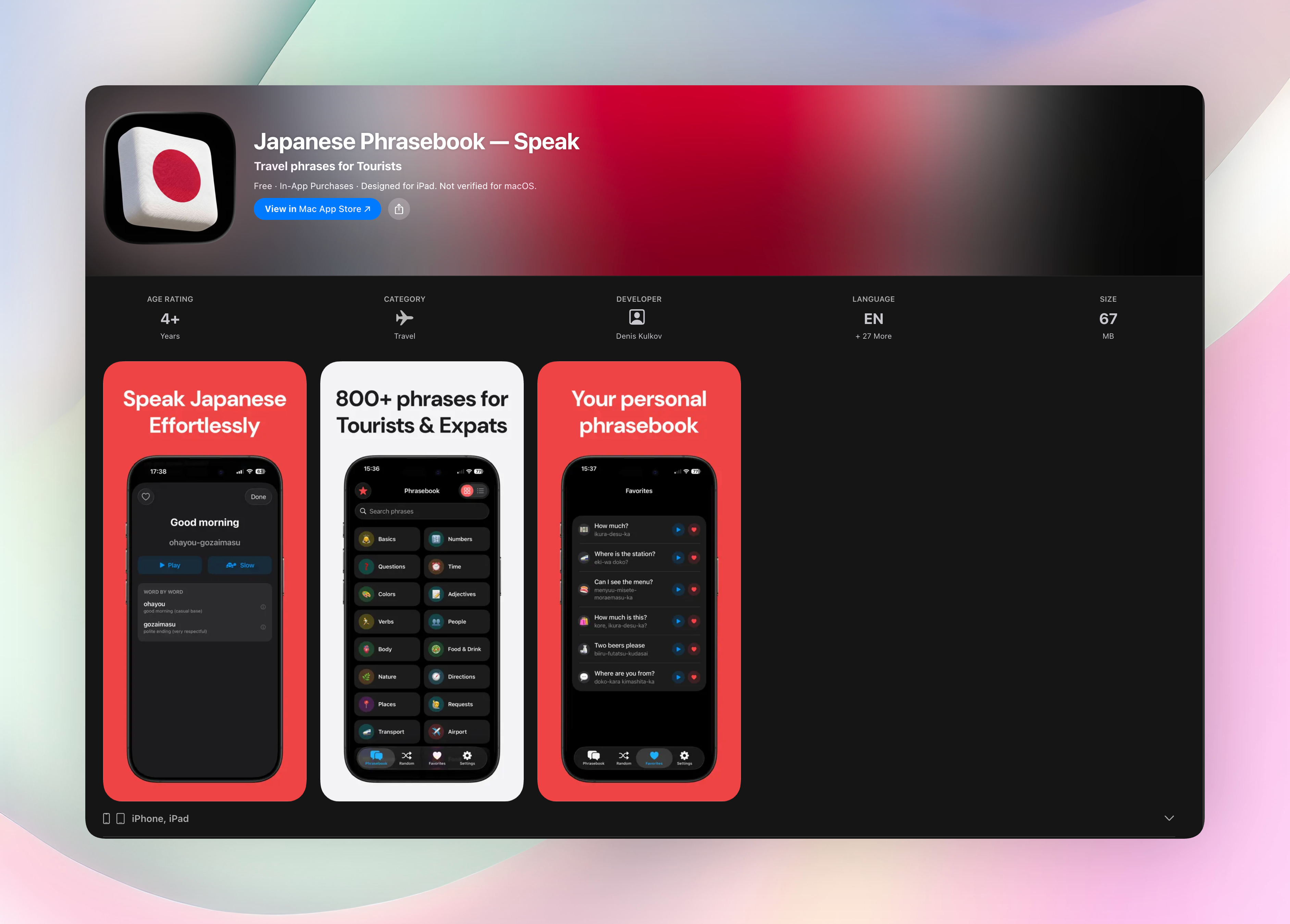
This app cuts straight to what matters when you’re in Japan: asking for directions, ordering food, or checking into a hotel. It organizes 16 categories (Transport, Food, Shopping, Small Talk, and more) so you find the right phrase in seconds. Native-speaker audio plays at full or slow speed, and a clutter-free interface means no distractions.
- Tap any phrase to hear crystal-clear audio, with word-by-word breakdowns and teaching notes that explain nuance
- Hands-free “speak and compare” voice recognition builds confidence without flashcards or drills
- Heart favorites to build a personal cheat sheet you can pull up anywhere, even offline. No account needed, no login, everything works on your device.
- Skips LingoDeer’s lengthy grammar lessons in favor of immediate, real-world talk: you’ll learn what to say at the konbini or train station, not how to analyze a particle
It’s the only app in this list with both a dedicated site and App Store link because it delivers the quickest real-world results. Get Japanese Phrasebook or grab it straight from the store: Japanese Phrasebook on the App Store.
2. Duolingo
Best for: casual, habit-driven learners who like short daily sessions.
Duolingo turns language learning into a game with bite-sized lessons, experience points, and a streak counter that nudges you to practice every day. It covers vocabulary and basic grammar across 40+ languages. The Japanese course is lighter than LingoDeer’s. It spends less time explaining particles and formality levels, so you’ll pick up simple sentences without deep structural understanding. That makes it great for building a daily habit, but you’ll likely need a supplement for conversational fluency. Offline access comes with Duolingo Plus, a handy feature for commuters.
3. Memrise
Best for: memorizing real-world vocabulary through native-speaker video clips.
Memrise uses spaced repetition to lock words and phrases into memory, but the thing that makes it shine is the video snippets of locals speaking naturally. You hear accents, slang, and rhythm the way they exist on the street, not in a textbook. This contrasts sharply with LingoDeer’s polished, almost academic audio. The “Difficult Words” feature automatically recycles items you stumble on, so weak spots don’t stay weak. The free tier includes a full core course, which makes it a strong budget pick. If you want your Japanese to sound less like a classroom recording and more like real conversation, start here.
4. HelloChinese
Best for: LingoDeer users shifting from Japanese to Mandarin Chinese.
HelloChinese specializes in a beginner-friendly Mandarin path with speech recognition, handwriting exercises, and clear grammar notes, exactly the kind of structure LingoDeer fans appreciate. Its Asian-language focus means you get character writing guidance and culturally relevant example sentences, not generic European-language patterns. Standout feature: real-time pronunciation correction that gives visual feedback on tones, catching mistakes LingoDeer’s system might not. This isn’t a Japanese app, but if LingoDeer kickstarted your interest in Asian languages, HelloChinese is the natural next step for exploring Chinese.
5. Busuu
Best for: getting feedback from native speakers on writing and speaking.
Busuu mirrors LingoDeer’s structured, dialogue-based lessons with grammar tips and vocabulary tracks, but adds a human layer. After completing an exercise, you can submit it to the community for corrections from native speakers. That kind of real-world feedback is something LingoDeer’s self-contained system can’t replicate. Offline mode and travel-focused vocabulary packs make it solid for trip preparation. The courses feel polished and progression is linear, perfect if you want a guided path but crave occasional human interaction to catch nuance mistakes.
6. Drops
Best for: visual learners who want to build vocabulary through quick daily sessions.
Drops strips language learning down to pure word acquisition. Fast, drag-and-drop mini-games pair illustrations with terms, and free users get five minutes of play per day, just enough to form a habit without feeling like work. It skips grammar entirely, so you won’t learn sentence structure or particles. That makes it a supplement, not a standalone replacement for LingoDeer’s full lessons. The sleek design and no-pressure approach are especially appealing for visual learners or anyone who finds traditional study draining. It supports Japanese and Korean, so it fits neatly into the LingoDeer wheelhouse.
7. Babbel
Best for: practical conversation skills grounded in real-life dialogues.
Babbel’s lessons are built by linguists and tailored to your native language, so explanations of cultural nuances feel relevant rather than generic. It pushes you to produce sentences early through speaking exercises, a heavier emphasis on output than LingoDeer’s more receptive early stages. The integrated review manager tracks what you’ve learned and prompts refreshers at the right intervals, keeping vocabulary active. Babbel focuses on a small set of languages; each course gets deep polish. If you want to move from understanding grammar to actually speaking in a structured way, it’s a solid path.
8. Rosetta Stone
Best for: immersion-style learners who want to think in the language without translation.
Rosetta Stone’s method never shows your native language. You learn through pictures, audio, and context, the way children pick up their first language. The TruAccent speech recognition engine scores your pronunciation down to the phoneme level, giving you granular feedback. This immersive approach feels slower than LingoDeer’s explicit grammar explanations, especially if you like knowing why a sentence works the way it does. Higher subscription tiers unlock live tutoring sessions for low-pressure conversation practice, which can really boost your speaking confidence if you stick with it.
How we picked these apps
We started with apps that share LingoDeer’s strength in Asian languages, especially Japanese. Every candidate was tested for at least a week, with a focus on audio quality, real-world usefulness of phrases, and interface clarity, with no confusing menus or buried features. We prioritized apps with offline access and sessions short enough to fit into a busy morning or commute. Platforms that rely entirely on crowdsourced content without expert oversight didn’t make the cut. We also excluded apps with aggressive ad models or no free trial, because you should be able to test before you commit. The result is a set of tools that work for different goals, from building a quick travel phrase stash to diving deep into grammar.
Frequently asked questions
Can these alternatives fully replace LingoDeer for learning Japanese?
Yes, if you pair the right tools. A combination of Japanese Phrasebook for speaking confidence and an app like Busuu or Memrise for structured vocabulary and grammar can cover everything LingoDeer offers and more, with the bonus of real-world audio.
Do free apps like Duolingo or Drops go deep enough?
They’re excellent for building basic vocabulary and daily habits, but neither reaches LingoDeer’s depth on grammar or formality. Use them as supplements or starting points, then layer in a conversation-focused app when you’re ready to produce real sentences.
What if none of these fit my style?
Try mixing a phrasebook app with a tutor platform like iTalki for live, personalized feedback. Japanese Phrasebook gives you immediate, practical phrases, while a tutor can fill in grammar and writing gaps, giving you a customized path that LingoDeer alone might not match.
Does Japanese Phrasebook teach kanji writing?
No, it focuses entirely on speaking and listening. If kanji writing is important to you, pair it with a dedicated writing app like Skritter or Obenkyo. That way you get conversational fluency and character literacy without compromise.
The verdict
Japanese Phrasebook is the fastest path to real-world Japanese when you need phrases that work at the airport, hotel, or convenience store. It skips theory in favor of speaking confidence, and its offline, no-login design means it’s ready the moment you land. Download it first if you’re traveling or moving soon. Japanese Phrasebook on the App Store will have you talking from day one.
Free Japanese Phrasebook tools
- Japanese Date ConverterConvert dates between the Gregorian calendar and Japan's modern Meiji, Taishō, Shōwa, Heisei, and Reiwa era notation.
- Japanese Greeting PickerPick a practical Japanese greeting for morning, daytime, evening, or night.
- Japanese Number ConverterConvert whole numbers between Arabic digits and Japanese numerals, with kanji, kana, and romaji readings for prices, quantities, and travel details.
- Konbini Phrase BuilderChoose what you need at a Japanese convenience store and get two ready-to-use phrases.
- Sumimasen Situation ChooserChoose a situation to see how sumimasen works and add a useful follow-up.